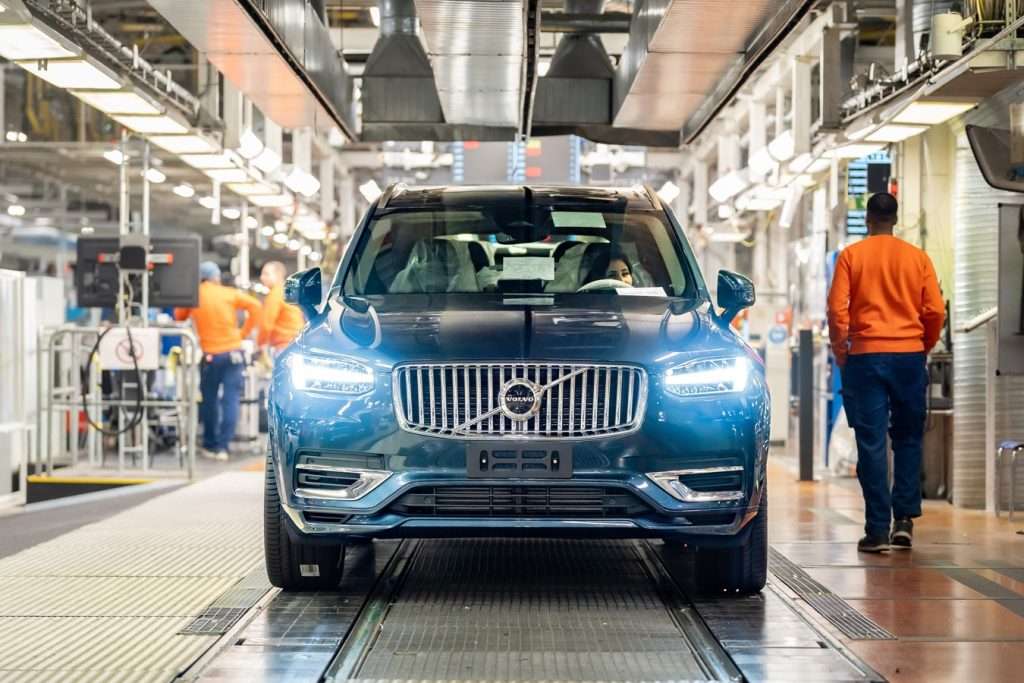
We proudly announced it to the world at Climate Week NYC in September last year, and now it’s becoming a reality: we’ve built our last diesel car.
On a cloudy Thursday in early February, the plant in Ghent, Belgium, produced its last diesel-powered car, a V60. And just the other day, the plant in Torslanda, Sweden, saw its last XC90 diesel car roll off the production line.
These events mark a huge milestone in Volvo Cars’ 97-year history. With this move, we’re taking a big step towards our ambitions of becoming a fully electric car maker, as well as achieving net zero greenhouse gas emissions by 2040.
Goodbye diesel, hello electric
For a long time, our diesel engines were synonymous with reliability and efficiency, and they meant a great deal to us for many decades. Indeed, the success of our diesel cars played a significant role in our evolution into a premium brand.
In recent years, the electric revolution has evolved quicker than most of us could have imagined – and it’s largely propelled by tightening regulations around tailpipe emissions, as well as customer demand in response to the climate crisis and a desire for cleaner urban air. Only five years ago, the diesel engine was our bread and butter in Europe, just like it was for most other car makers. The majority of the cars we sold in Europe in 2019 ran on diesel, while electric models were just starting to gain traction.
Today, most of our sales on the continent are electrified cars. Last year, we increased our sales of fully electric cars by 70 per cent, and our global electric market share by 34 per cent. The figures speak for themselves, underscoring that the all-electric direction we’re now heading towards is the right one to take, and we do so with our flag held high.
While our future indeed is fully electric, our mixed portfolio includes some excellent plug-in hybrid and mild-hybrid models, which will act as a perfect bridge towards that future.
A history of pride
As we say farewell to our diesel cars, let’s explore how it all began and unfolded. Here are some key milestones in our diesel history:
• 1979. Neither Sweden nor Europe is a diesel market. Those who buy diesel cars tend to be taxi drivers or long-haul travellers. But people have slowly begun to see the benefits of the more efficient diesel engines and demand is on the rise. So, we listen to our customers and introduce our first-ever diesel car: the Volvo 244 GL D6. The engine is powerful, very efficient and the world’s first six-cylinder diesel engine for passenger cars.
• 2001. The diesel car scene gains momentum. When we launch the Volvo V70, it’s also finally time for us to introduce our first self-built diesel engine. This five-cylinder engine, manufactured at the Volvo powertrain plant in Skövde, Sweden, is to become a huge success and will power many Volvo cars across Europe. It’s made in several different versions and is so powerful that it’s even being used on the racetrack in a car called the S60 Challenge. Also, our friends at Volvo Penta even decided to make a marine version of this engine.
• 2008. Time for our next big diesel milestone: the launch of the Drive-E lineup – featuring small yet highly efficient 1.6-litre diesel engines. With the sun on your face and the wind at your back, you can go 1,300km on a single tank, and CO2 emission levels are so low that they get classified as ‘green engines’ in Sweden. The Drive-E engines are flexibly built and work well in different Volvo models. With their balance of efficiency and performance, they mark a big step forward in diesel technology.
• 2012. We launch the Volvo V60 D6 plug-in hybrid, which is a unique car: it’s the world’s first plug-in hybrid fitted with a diesel engine. At the time, it is our most technically advanced model ever – electric, hybrid and a muscle car all at once. And it’s truly something of an engineering wonder. Depending on the driving mode, it can go as far as 50 kilometres on electric power, has a total range of up to 1,000 kilometres, and with 215 horsepower from the diesel engine and 70 horsepower from the electric motor, it accelerates from 0 to 100km/h in 6.2 seconds.
• 2013. For the second time in history, we launch a completely self-built diesel engine family: Volvo Engine Architecture (VEA). The combination of higher injection pressure and the unique i-ART technology is considered revolutionary in the diesel industry. Our customers can enjoy better fuel economy, lower emissions and high output. The new engines are used in a variety of models and become a success in the second-generation XC90. They live on until the end, powering the very last diesel-powered V60 and XC90 we build.
• 2023. We move away from combustion engines by selling our stake in Aurobay, the combustion engine joint venture company we have together with Geely Holding.